User:Danenberg
Provenance
Of Gens Danenbergorum; Peter Charles Danenberg, Jr.
Officium
MediaWiki Development; namely WikiTeX
Sandbox
Direction field
Reproduced from William E. Boyce and Richard C. DiPrima, Elementary Differential Equations and Boundary Problems (Hoboken: John Wiley, 2005), 35.
<plot>set isosamples 20 set samples 20 l = 0.05 f(t,y) = 2*y + 4 - t g(c,x) = -7/4. + 1/2.*x + c*exp(2*x) plot [0:2][-4:0] '+' using 1:2:(l):(l*f($1,$2)) \
with vectors nohead title "dy/dt - 2y = 4 - t", \
g(0,x) title "g(c, t) = -7/4 + 1/2t + ce^2t, c = 0", \
g(.1,x) lt 2, g(.2,x) lt 2, g(.3,x) lt 2, g(-.1,x) lt 2, \
g(-.2,x) lt 2, g(-.3,x) lt 2
</plot>
Vector field
Gradient vector field of <amsmath>f(x,y) = \sin x + \sin y</amsmath> along with its contour map, courtesy of a beautiful hack by Thomas Sefzick.
<plot>f(x, y) = sin(x) + sin(y) set multiplot set contour set cntrparam level 10 set view map set xrange [-6:6] set yrange [-6:6] unset surface unset key set isosamples 100,100 set samples 100,100 splot f(x, y) unset contour set isosamples 30,30 set samples 30,30 set surface set key l = 0.5 set border 0 unset tics splot '+' using 1:2:(0.0):(l*cos($1)):(l*cos($2)):(0.0) with vectors title "f(x,y) = sin(x) + sin(y)" </plot>
Tangent planes
At increasing levels of detail, the surface approaches its tangent plane around P.
Falling leaf
<plot> set multiplot layout 1,3 set hidden3d set xrange [-9:11] set yrange [-9:11] set view 85,30 set label "P(1,1,5)" at 1,1,5 point lt 1 pt 7 offset 1,-1 f(x,y) = x**2 + x*y + 3*y**2 df(x,y) = 3*x + 7*y - 5 set title "1x" splot f(x,y) title "f(x,y) = x^2 + xy + 3y^2", \
df(x,y) title "df(x,y) = 3x + 7y - 5"
unset key set xrange [0:2] set yrange [0:2] set title "10x" splot f(x,y), df(x,y) set xrange [.9:1.1] set yrange [.9:1.1] set title "100x" splot f(x,y), df(x,y) </plot>
Anti-intuition
<plot> set multiplot layout 1,3 set isosamples 20,20 set hidden3d set xrange [-9:11] set yrange [-9:11] set label "P(1,1,0)" at 1,1,0 point lt 1 pt 7 offset 1,-1 f(x,y) = (x*y*sin(x - y)) / (1 + x**2 + y**2) df(x,y) = (x - 1) / 3. - (y - 1) / 3. set title "1x" splot f(x,y) title "f(x,y) = (xy sin(x - y)) / (1 + x^2 + y^2)", \
df(x,y) title "df(x,y) = (x - 1) / 3 - (y - 1) / 3"
unset key set xrange [0:2] set yrange [0:2] set title "10x" splot f(x,y), df(x,y) set xrange [.9:1.1] set yrange [.9:1.1] set title "100x" splot f(x,y), df(x,y) </plot>
Linear independence
Problem
If <amsmath>f_k(x) = x^k</amsmath> for <amsmath>k = 0,1,\dots,n</amsmath>, show that <amsmath>\{f_0, f_1, \dots, f_n\}</amsmath> is linearly independent on every interval for all fixed <amsmath>n</amsmath>.
Wronskian
<amsmath>f_k(x)=x^k \rightarrow W[f_0,f_1,\ldots,f_n](x) = \begin{vmatrix}
1 & x & \cdots & x^{n-1} & x^n\\
0 & 1! & \cdots & (n-1)x^{n-2} & nx^{n-1}\\
\vdots & \vdots & & \vdots & \vdots\\
0 & 0 & \cdots & (n-1)! & n!x\\
0 & 0 & \cdots & 0 & n!
\end{vmatrix} =\prod_{i=0}^ni!\neq0</amsmath>
Solution
<amsmath>\{f_0, f_1, \ldots, f_n\}</amsmath> has a non-zero Wronskian on <amsmath>n\in\mathbb{N}</amsmath>; and is therefore linearly independent on that interval.
Clairaut's Theorem
That <amsmath>f_{xy}(0,0) = -1 \neq f_{yx}(0,0) = 1</amsmath> does not contradict Clairaut's Theorem <amsmath>f_{x_{p_1}\cdots x_{p_n}} = f_{x_{q_1}\cdots x_{q_n}}</amsmath>, where <amsmath>P = \{p_1, \ldots, p_n\}</amsmath> and <amsmath>Q = \{q_1, \ldots, q_n\}</amsmath> are permuted indices of <amsmath>X = \{x_1, \ldots, x_n\}</amsmath> with replacement, since <amsmath>f_{xy}</amsmath> and <amsmath>f_{yx}</amsmath> are not continuous.
<plot> reset set multiplot layout 1,2 set isosamples 100,100 set hidden3d splot (x**3*y - x*y**3) / (x**2 + y**2) title "f(x, y) = (x^3y - xy^3) / (x^2 + y^2)" splot (x**4*y + 4*x**2*y**3 - y**5) / (x**2 + y**2) title "f_x(x, y) = (x^4y + 4x^2y^3 - y^5) / (x^2 + y^2)", \
(x**5 - 4*x**3*y**2 - x*y**4) / (x**2 + y**2) title "f_y(x, y) = (x^5 - 4x^3y^2 - xy^4) / (x^2 + y^2)"
</plot>
Violent curiosity
Tangent at a point of plane-ellipsoid intersection:
<plot> set yrange [1:3] set xrange [-2:2] set parametric set hidden3d set isosamples 100,100 set label "(1,2,2)" center at 1,2,12 offset 0,0.2 set arrow from 1,2,2 to 1,2,12 backhead splot 2*cos(u)*cos(v),sqrt(8.)*sin(u)*cos(v),4*sin(v) title "f(x, y, z) = 4x^2 + 2y^2 + z^2 = 16", \
u,2,v title "y = 2", \
1+u, 2, -2*u + 2 lw 3 title "f_x(x, y, z) at (1, 2, 2)"
</plot>
Partial derivatives
<plot> set multiplot layout 1,2
- set xrange[-5:5]
- set yrange[-5:5]
set view 79,285 set isosamples 30,30 set hidden3d splot x**2 + y**2 + x**2*y title "f(x, y) = x^2 + y^2 + x^2y" splot 2*x + 2*x*y title "f_x(x, y) = 2x + 2xy", \
2*y+x**2 title "f_y(x, y) = 2y + x^2"
</plot>
Limit
That-<amsmath>\lim_{(x,y)\rightarrow(0,0)}\frac{2x^2+3xy+4y^2}{3x^2+5y^2}</amsmath>-doesn't-exist's graphical representation.
<plot>set hidden3d set view 65,77 set isosamples 100,100 set label "{\254}{/Symbol \044} lim_{(x,y) {/Symbol \256} (0,0)}f(x), since:\nf(0,y) {/Symbol \256} 4/5, f(x,0) {/Symbol \256} 2/3,\nf(x,x) {/Symbol \256} 9/8 as (x,y) {/Symbol \256} (0,0)." at 0,0,0 point lt 1 pt 7 offset 1,-1 splot (2*x**2 + 3*x*y + 4*y**2) / (3*x**2 + 5*y**2) title "(2x^2 + 3xy + 4y^2) / (3x^2 + 5y^2)" </plot>
Family of curves
<plot>set multiplot set isosamples 60,60 set xrange [-10:10] set yrange [-10:10] set zrange [0:1000] f(x,y) = exp(c*x**2 + y**2) c = 0 splot f(x,y) lt 1 title "e^{cx^2 + y^2}, c = \\{-2, -1, 0, 1 ,2\\}" unset key unset tics set border 0 c = 1 splot f(x,y) lt 2 c = 2 splot f(x,y) lt 3 c = -1 splot f(x,y) lt 4 c = -2 splot f(x,y) lt 5 </plot>
Curve with contour
<plot>set xrange[-2:2] set yrange[-2:2] set hidden3d set isosamples 100,100 set contour set grid set view ,,,1.5 f(x,y) = (1-3*x**2+y**2)*exp(1-x**2-y**2) splot f(x,y) title "(1 - 3x^2 + y^2)e^{1 - x^2 - y^2}" </plot>
Erotic paraboloid
<plot>set pm3d at s hidden3d 100 set style line 100 lt 5 lw 0.5 unset hidden3d unset surf unset key unset tics unset contour unset colorbox set border 0 set isosamples 100,100 range = 3 zrange = 1.2 set xrange[-range:range] set yrange[-range:range] set zrange[0:zrange] splot (x**2+3*y**2)*exp(-(x**2)-(y**2))</plot>
Context from #math on freenode:
00:57 <klutometis> I've come up with a new nomination: the "erotic
paraboloid"
00:57 <klutometis> http://wikisophia.org/wiki/User:Danenberg#Erotic_paraboloid
00:58 <thermoplyae> you appear to have a lot of free time
00:59 <klutometis> thermoplyae: me? it corresponds roughly with calculus;
so no expenditure of free time
00:59 <TRWBW> klutometis: hehe, n1, something just like it at
http://www.youtube.com/watch?v=eBGIQ7ZuuiU
01:00 <thermoplyae> you say that, but all the busy people i know don't draw
graphs of "co-sinusoidal demi-toroid"s
01:00 <klutometis> damn it, TRWBW; I can't believe I got rick rolled
01:00 <thermoplyae> just sayin'
01:00 <thermoplyae> haha
01:01 <klutometis> thanks, boys; good night
Osculating cirles
<plot> set parametric set label "C_r(0, 0)" at 0, 0 point lt 1 pt 7 offset 1, -1 set label "O_{rs}(2, 0)" at 2, 0 right point lt 1 pt 7 offset 1, -1 set label "O_{rt}(0, 3)" at 0, 3 point lt 1 pt 7 offset 1, -1 set label "C_s(0, 5/3)" at 0, 5/3. point lt 2 pt 7 offset 1, -1 set label "C_t(-5/2, 0)" at -5/2., 0 point lt 3 pt 7 offset 1, -1 plot 2*cos(t), 3*sin(t) title "r(t) = <2cos(t), 3sin(t)>", \
(4/3.)*cos(t), 5/3. + (4/3.)*sin(t) title "s(t) = <4/3cos(t), 5/3 + 4/3sin(t)>", \
-(5/2.) + (9/2.)*cos(t), (9/2.)*sin(t) title "t(t) = <-5/2 + 9/2cos(t), 9/2sin(t)>"
</plot>
Tangent, normal, binormal
<plot>set parametric set label "P(1, 2/3, 1)" at 1,2/3,1 point lt 1 pt 7 offset 1,-1 splot u**2, (2.0/3)*u**3, u title "r(t) = <t^2, 2/3t^3, t>", \
1+2*u/3.0, 2/3+2*u/3.0, 1+u/3.0 title "T(t) = <-2t^2, 2t, -2t> / 2(2t^2+1)^2, t = 1", \
1-u/3.0, 2/3+2*u/3.0, 1-2*u/3.0 title "N(t) = <-2t^2+1, 2t, -2t> / (2t^2+1), t = 1", \
1-2*u/3.0, 2/3+1*u/3.0, 1+2*u/3.0 title "B(t) = T(t) x N(t), t = 1"
</plot>
Curvature of e
<plot> set xrange[-5:2] set yrange[0:1] f(x) = exp(x) k(x) = exp(x) / (sqrt(1 + exp(2*x))**3) dk(x) = (exp(x) * (1 - 2*exp(2*x)))/(sqrt(1+exp(2*x))**5) set label "{/=12 {/Symbol k}_{max}}" at -log(2)/2,f(-log(2)/2) point lt 1 pt 7 offset 1,-1 plot f(x) title "f(x) = e^x", \ k(x) title "{/Symbol=9 k}(x) = e^x/(1+e^{2x})^{3/2}", \ dk(x) title "d{/Symbol=9 k}/dx(x) = e^x(1 - 2e^{2x})/(1+e^{2x})^{5/2}" </plot>
<t, t², t³> ∩ <sin(t), sin(2t), t>
<plot>set parametric set xrange[-1:1] set yrange[-1:1] set zrange[-4:4] splot u, u**2, u**3 title "r(t) = <t, t^2, t^3>",\ sin(u), sin(2 * u), u title "s(t) = <sin(t), sin(2t), t>",\ u, 0, 0 title "d/dt r(0)",\ u, 2*u, u title "d/dt s(0)"</plot>
Cylinder ∩ paraboloid
<plot>set multiplot layout 1,2 set isosamples 40, 40 set parametric set hidden3d set xrange[-2:2] set yrange[-2:2] set zrange[0:4] set parametric splot 2*cos(u), 2*sin(u), v title "x^2 + y^2 = 4", u, v, u**2 title "z = x^2" unset hidden3d splot 2 * cos(u), 2 * sin(u), 4 * cos(u)**2 title "r(t) = <2cos(t), 2sin(t), 4cos^2(t)>"</plot>
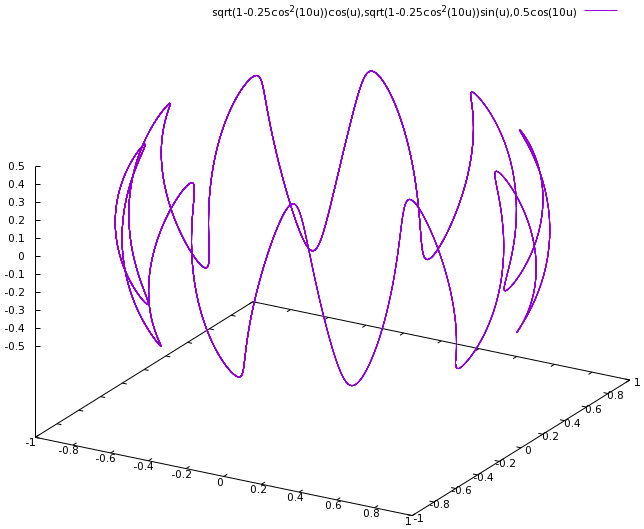
Co-sinusoidal demi-toroid
<plot>set term cairopng size 8,6 font ",8" linewidth 3 enhanced set parametric set samples 1000, 1000 splot sqrt(1 - 0.25 * (cos (10 * u))**2) * cos(u), sqrt(1 - 0.25 * (cos (10 * u))**2) * sin(u), 0.5 * cos (10 * u) title "sqrt(1-0.25cos^2(10u))cos(u),sqrt(1-0.25cos^2(10u))sin(u),0.5cos(10u)"</plot>
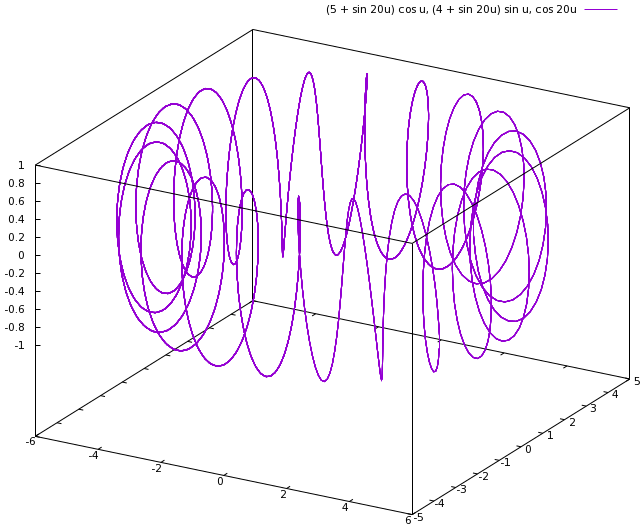
Toroidal spiral
<plot>set term cairopng size 8,6 font ",8" linewidth 3 enhanced set samples 1000, 1000 set parametric set border 4095 splot (5 + sin(20 * u)) * cos(u),(4 + sin(20 * u)) * sin(u), cos(20 * u) title "(5 + sin 20u) cos u, (4 + sin 20u) sin u, cos 20u"</plot>
Orthogonal matrices
Problem
<amsmath>\end{displaymath} \(A=\begin{bmatrix} \cos{\alpha}&\sin{\alpha}\\ -\sin{\alpha}&\cos{\alpha} \end{bmatrix}\); prove \(A^T=A^{-1}\) (\emph{id est}, that A is orthogonal). \begin{displaymath} </amsmath>
Inverse matrix
<amsmath> \end{displaymath} \newcommand{\cosa}[0]{ %
\cos{\alpha} %
} \newcommand{\coscosa}[0]{ %
\cos^2{\alpha} %
} \newcommand{\coscoscosa}[0]{ %
\cos^3{\alpha} %
} \newcommand{\sina}[0]{ %
\sin{\alpha} %
} \newcommand{\sinsina}[0]{ %
\sin^2{\alpha} %
} \begin{align*} \left[A I_n\right] &\sim \left[I_n A^{-1}\right]\\ \left[A I_n\right] &= \begin{bmatrix}
\cosa & \sina & 1 & 0\\ -\sina & \cosa & 0 & 1
\end{bmatrix}\\ &\stackrel{1}{\sim} \begin{bmatrix}
\coscosa & \sina\cosa & \cosa & 0\\ \sinsina & -\sina\cosa & 0 & -\sina
\end{bmatrix}\\ &\stackrel{2}{\sim} \begin{bmatrix}
\coscosa & \sina\cosa & \cosa & 0\\ \sinsina + \coscosa & \sina\cosa - \sina\cosa & \cosa & -\sina
\end{bmatrix}\\ &= \begin{bmatrix}
\coscosa & \sina\cosa & \cosa & 0\\ 1 & 0 & \cosa & -\sina
\end{bmatrix}\\ &\stackrel{3}{\sim} \begin{bmatrix}
\coscosa & \sina\cosa & \cosa & 0\\ \coscosa & 0 & \coscoscosa & -\sina\coscosa
\end{bmatrix}\\ &\stackrel{4}{\sim} \begin{bmatrix}
\coscosa - \coscosa & \sina\cosa & \cosa - \coscoscosa & \coscosa\sina\\ \coscosa & 0 & \coscoscosa & -\sina\coscosa
\end{bmatrix}\\ &= \begin{bmatrix}
0 & \sina\cosa & \cosa\sinsina & \coscosa\sina\\ \coscosa & 0 & \coscoscosa & -\sina\coscosa
\end{bmatrix}\\ &\stackrel{5}{\sim} \begin{bmatrix}
0 & 1 & \sina & \cosa\\ 1 & 0 & \cosa & -\sina
\end{bmatrix}\\ &\stackrel{6}{\sim} \begin{bmatrix}
1 & 0 & \cosa & -\sina\\ 0 & 1 & \sina & \cosa
\end{bmatrix}\\ &= \left[I_n A^{-1}\right] \end{align*} \begin{enumerate} \item{\(M_1(\cosa)\), \(M_2(-\sina)\)} \item{\(A_{12}(1)\)} \item{\(M_2(\coscosa)\)} \item{\(A_{21}(-1)\)} \item{\(M_1(\frac{1}{\sina\cosa})\), \(M_2(\frac{1}{\coscosa})\)} \item{\(P_{12}\)} \end{enumerate} \begin{displaymath}</amsmath>
Solution
<amsmath> \end{displaymath} \begin{align*} A^{-1} &= \begin{bmatrix}
\cos{\alpha} & -\sin{\alpha}\\
\sin{\alpha} & \cos{\alpha}
\end{bmatrix}\\ &= A^T \end{align*} \begin{displaymath} </amsmath>
Surfaces
<plot>set multiplot layout 1,2 title "Surfaces and projection on xy" set hidden3d set xrange [-1.2:1.2] set yrange [-1.2:1.2] splot x**2 + y**2 title "x^2 + y^2", 1 - y**2 title "1 - y^2" set parametric plot sin(t),cos(t)/sqrt(2) title "x^2 + 2y^2 = 1"</plot>
Fugale Gelehrtheit
<music>{ \time 4/4 \clef violin \key dis \minor \relative c' << { d'1\rest d1\rest d2\rest ais4\fermata } \\ { dis,4 ais'4. b8 ais gis fis gis ais4 dis, gis~ gis8 fis eis4 dis4 } >> } </music>
Index conjecture
Let <amsmath>I</amsmath> be the index set to the n-ary Cartesian product of set <amsmath>A_1, \dots, A_n</amsmath> of cardinalities <amsmath>a_1, \dots, a_n</amsmath>. Therefore, <amsmath>I = \{0, 1, \dots, \Pi_{i=1}^na_i\}</amsmath>; let <amsmath>i = I_i</amsmath>.
Let, furthermore, <amsmath>{J_k}_i</amsmath> be the index of set <amsmath>A_k</amsmath> corresponding to <amsmath>i</amsmath>.
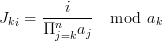
Finally, <amsmath>{J_k}_i = \frac{i}{\Pi_{j=k}^na_j}\mod{a_k}</amsmath>